In our previous article, we clarified the Italian CEI UNEL 35011 system (the one behind the well-known FG16R16 cable). However, as anyone working on-site or in procurement knows, today’s market has no borders. It is very common to come across cables whose codes seem written in a completely different language. And, in a way, they are: this is the “European language”. Today we will explore how the European Harmonised designation system (HD 361 S4) works, by breaking down one of the most in-demand codes at the moment: the SADASOLAR H1Z2Z2-K photovoltaic cable.
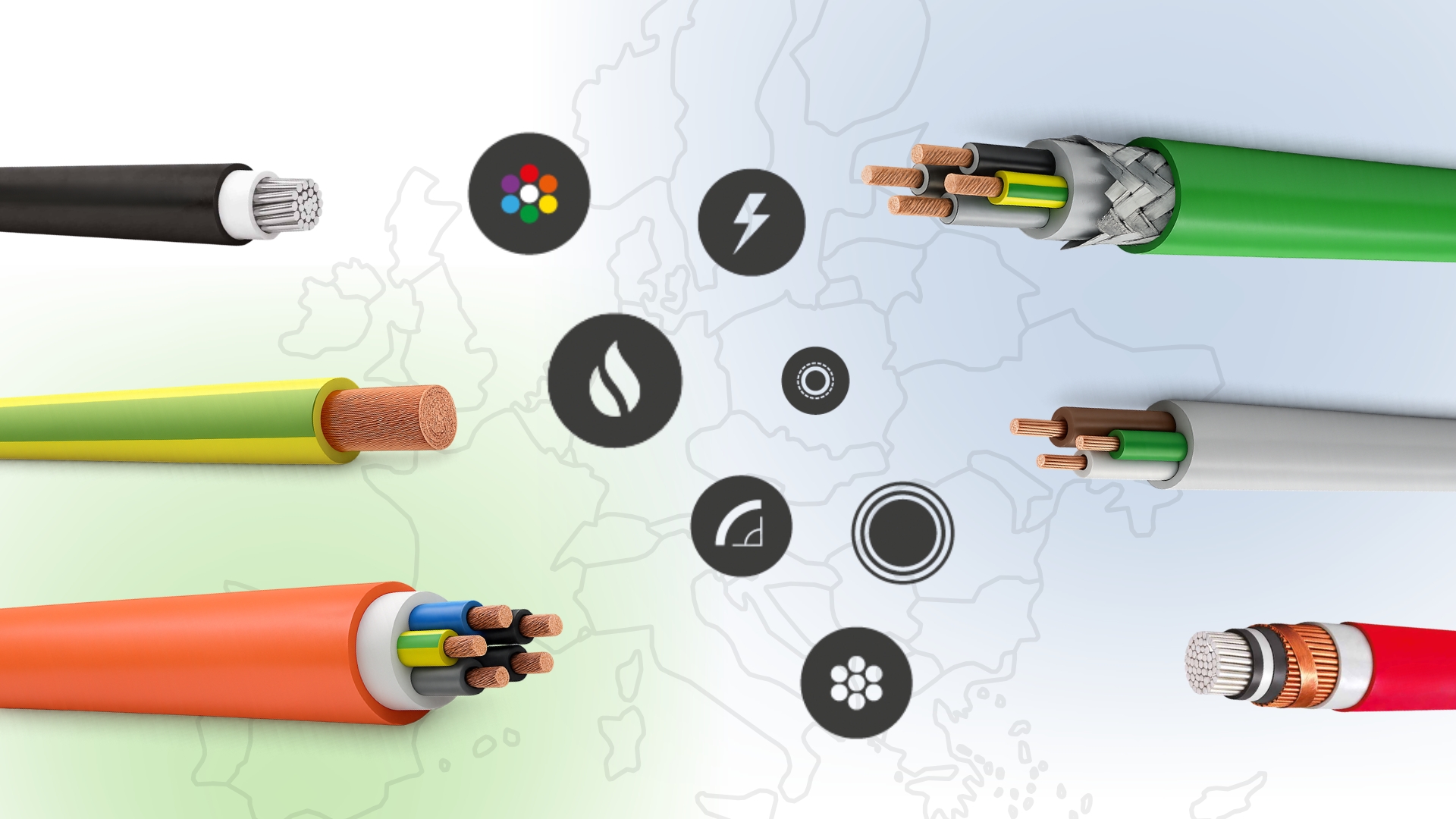
What is the European Harmonised designation system?
The Harmonised system, defined at European level by the HD 361 S4 standard (adopted in Italy as CEI 20-27), was created with a practical goal: to allow a cable manufactured in Italy to be installed in Germany, France or Spain without the need to “translate” its technical specifications.
While the Italian CEI UNEL system starts from the conductor and moves outward to the sheath, the Harmonised system follows a slightly different logic, arranging information in this order:
- Reference to the standard (prefix): the first letter indicates whether the cable complies with European standards.
- Rated voltage: two numbers indicating the supported voltage range.
- Insulation material: the compound in direct contact with the conductor.
- Sheath material: the external protective layer.
- Conductor type (suffix): placed at the end, after a dash, it indicates the structure and flexibility of the conductor.
The structure of the code
To give you a practical tool you can always keep at hand on-site or in the office, here is an overview of the most common letters and numbers you may encounter when reading an HD 361 S4 / CEI 20-27 code.
1. Standard reference
• H: Harmonised cable (compliant with CENELEC European standards)
• A: Nationally authorised cable
2. Rated voltage (U0/U)
• 01: 100/100 V
• 03: 300/300 V
• 05: 300/500 V
• 07: 450/750 V
• 1: 1000/1000 V (currently limited to photovoltaic cables)
3 & 4. Materials (Insulation and outer sheath)
The same letters are used in sequence to indicate first the insulation and then the sheath.
• V: Standard PVC (polyvinyl chloride)
• V2: High-temperature resistant PVC (up to 90°C)
• R: Natural or synthetic rubber (such as EPR)
• N: Polychloroprene rubber (Neoprene)
• Z: Cross-linked polyolefin compound with low smoke emission and non-corrosive gases
• Z1: Thermoplastic polyolefin compound with low smoke emission and non-corrosive gases
• Z2: Cross-linked polyolefin compound with low smoke emission and non-corrosive gases, specific for photovoltaic cables
• S: Silicone rubber, ideal for extreme temperatures
• Q: Polyurethane, highly resistant to abrasion and cuts
5. Metallic coverings (sheath, concentric conductors, screens)
• C: Copper concentric conductor
• C4: Copper braid over the assembled cores
6. Cable components
• D3: Supporting element consisting of one or more components
• D5: Central filler
7. Special constructions
• No symbol: Circular conductor
• H: Flat divisible cables
• H2: Flat non-divisible cables
• H6: Flat cables with three or more cores
• H7: Cable with double-layer insulation
• H8: Extendable cord
8. Conductor material
• No symbol: Copper
• -A: Aluminium
9. Suffix (conductor type, indicated after “-”)
• -U: Solid conductor (class 1)
• -R: Stranded rigid conductor (class 2)
• -K: Flexible conductor for fixed installation (class 5, e.g. solar cables or switchboards)
• -F: Flexible conductor for mobile installation (class 5, e.g. extension leads/tools)
• -D: Flexible conductor for welding cables
• -E: Extra-flexible for welding cables
• -H: Extra-flexible class 6
Practical example: decoding the H1Z2Z2-K photovoltaic cable
For next-generation photovoltaic systems, the benchmark cable (compliant with EN 50618) is the H1Z2Z2-K. Applying the HD 361 S4 rules, we can read its “identity card” block by block:
• H – Type of standard: the initial “H” is a guarantee mark. It stands for “Harmonised” and ensures the cable is recognised throughout Europe. (If it were “A”, it would mean “Authorised”, i.e. a recognised national type.)
• 1 – Rated voltage: this number defines the insulation voltage. “1” indicates 1/1 kV in alternating current (AC), which for EN 50618 solar cables corresponds to up to 1.5 kV in direct current (DC). Other common codes include 05 (300/500 V) and 07 (450/750 V).
• Z2 – Insulation: this identifies the cable’s inner layer. “Z2” stands for a halogen-free cross-linked compound (LSZH – Low Smoke Zero Halogen). It is a high-performance material that does not propagate flames, emits no toxic fumes and withstands high temperatures.
• Z2 – Outer sheath: the outer sheath is also “Z2”, meaning halogen-free cross-linked compound. In solar cables, this sheath must offer exceptional performance: resistance to UV rays, ozone and weathering for at least 25 years.
• -K – Conductor: the final suffix describes the core of the cable. “-K” indicates a flexible conductor (class 5) for fixed installation.
SADA CAVI expert note: in H1Z2Z2-K solar cables, regulations require the copper conductor to be tinned. Tinning protects the copper from oxidation in harsh outdoor environments, ensuring long-term conductivity. If it were a flexible cable for mobile use (such as construction site extension leads), the suffix would be -F.
In summary
Reading a code like H1Z2Z2-K should not be intimidating: the initial “H” places us within the European framework, the “1” defines the voltage level, the two “Z2” elements guarantee safe and environmentally friendly insulation and sheath, and the final “K” tells us the cable is flexible but designed for fixed installation (such as behind solar panels).
Do you have doubts about a specific designation or need to find the exact equivalent for a complex specification? The SADA CAVI team is here to help: contact us and we will find the perfect technical and commercial solution for your project.