In modern industrial systems, inverters, drives, brushless motors, sensors and automation systems are increasingly common. This evolution makes it possible to improve efficiency, control and process precision, but it also requires greater attention to the quality of electrical connections. In an automated system, a cable does not simply carry power or signals. It must contribute to the correct operation of the entire system, reducing the risk of interference, anomalies and machine downtime.
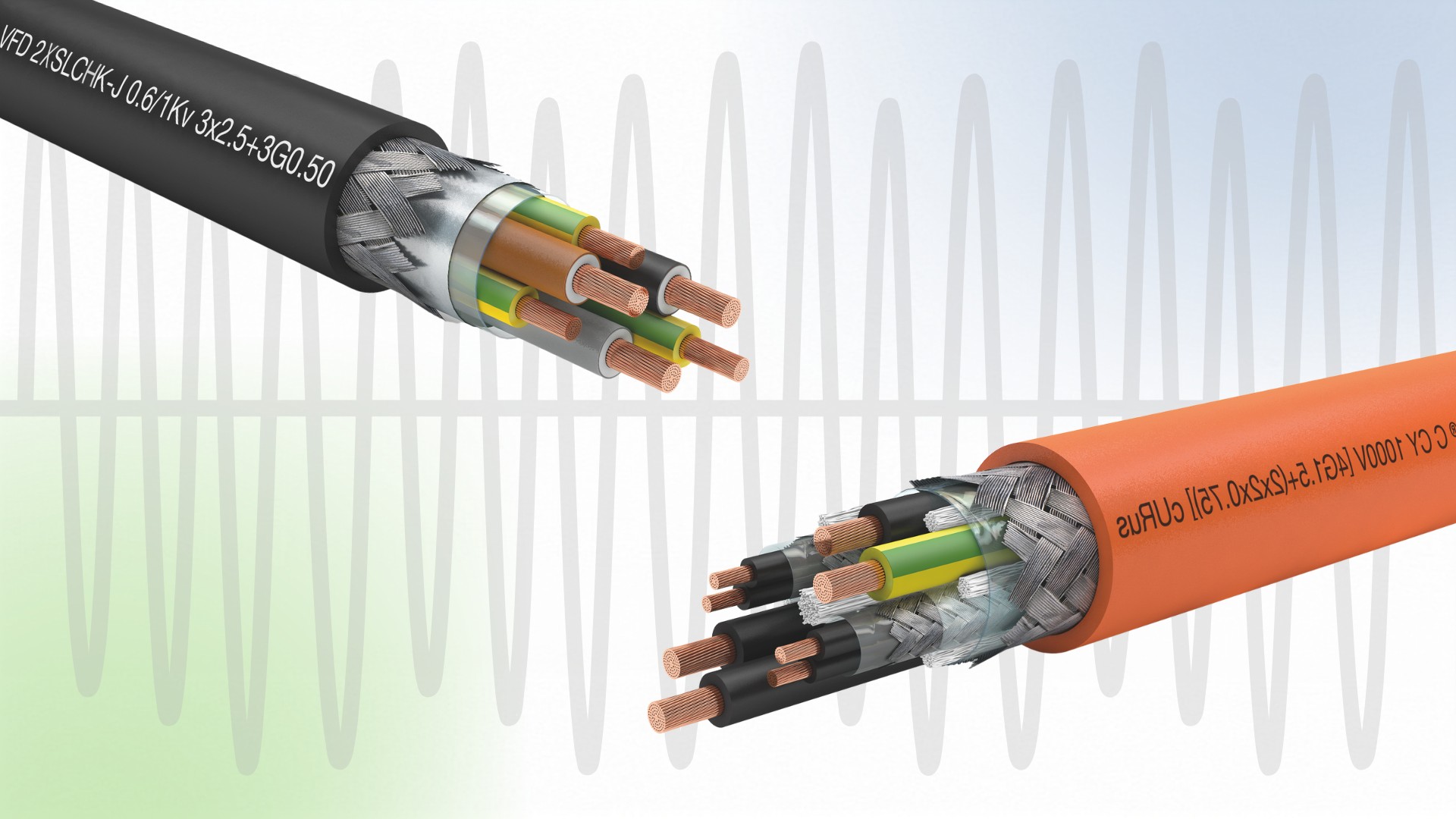
This is where EMC cables for inverters come into play. They are designed for applications in which electromagnetic compatibility is a fundamental requirement.
What EMC Means
EMC stands for Electromagnetic Compatibility.
This term refers to the ability of a device, system or installation to operate correctly in its electromagnetic environment, without generating disturbances and without being affected by interference from other components.
In industrial settings, this aspect is particularly important because machines, electrical panels, inverters, motors, PLCs, sensors and communication systems often operate in close proximity. If the system is not designed correctly, interference can compromise plant stability and make it more difficult to identify the source of problems.
Why Inverters Can Generate Interference
Inverters are essential components for regulating the speed and operation of electric motors. They are used in a wide range of industrial applications because they help optimise energy consumption, improve process control and make machine management more flexible.
However, their operation can generate electromagnetic interference.
The fast electrical switching typical of inverters can produce interference that propagates along the connection cables. If the cable is not suitable for the application, these disturbances can reach other devices in the system, such as sensors, encoders, control systems, communication networks or sensitive electronic equipment.
The result can be a series of anomalies that are difficult to diagnose: unstable signals, communication errors, intermittent malfunctions, sudden stops or inconsistent machine performance.
The Role of Shielding in EMC Cables
In EMC cables for inverters, shielding plays a central role.
A shielded cable is designed to limit the propagation of electromagnetic interference and help protect the signals and equipment within the system. Shielding helps contain the interference generated by the electrical connection and, at the same time, reduces the cable’s exposure to external disturbances.
This does not mean that shielding is the only factor to consider. The correct choice of cable must also take into account the cross-section, rated voltage, type of installation, cable length, operating temperature, installation environment and possible exposure to oils, chemical agents or mechanical stress. However, in applications with inverters, servomotors and brushless systems, shielding is often an essential condition for ensuring continuity, safety and long-term reliability.
Cables for Inverters, Brushless Motors and Automation: They Are Not All the Same
In the industrial automation sector, every application has specific requirements.
A cable intended to power a motor controlled by an inverter does not have the same characteristics as a signal cable, a bus cable, an industrial Ethernet cable or a cable for encoders and resolvers. Likewise, a cable for fixed installation cannot be selected using the same criteria as a cable intended for continuous movement or installation in drag chains.
For this reason, speaking generically of a “shielded cable” is not enough.
It is necessary to assess the application context: the type of machine, the level of disturbance in the environment, the distance between inverter and motor, installation conditions, the presence of other nearby cables, the required standards and the expected performance.
SADA CAVI offers several solutions for inverter, EMC and brushless applications, including shielded multicore cables for fixed installation, EMC cables resistant to industrial oils and compliant with UL/CSA standards, and shielded cables for servomotors, designed to meet the needs of industrial automation.
Discover the products recommended by SADA CAVI
The Most Common Mistakes When Choosing a Cable
One of the most common mistakes is choosing a cable based only on its cross-section or rated voltage, without assessing the environment in which it will be installed.
In complex industrial applications, this approach may not be sufficient. A cable that is formally correct from an electrical point of view may not be suitable for handling electromagnetic interference, industrial oils, high temperatures, installation in confined spaces or proximity to other conductors.
Another common mistake is underestimating the length of the connection between the inverter and the motor. The longer the cable, the more important it becomes to carefully consider the effects of interference and the quality of the shielding.
Installation also plays a decisive role. A cable installed incorrectly, placed too close to signal cables or used in a highly disturbed environment can cause problems even when the selected product is of good quality.
The correct design of the connection, therefore, does not depend only on the individual component, but on the balance between cable, system, installation method and operating conditions.
Choosing the Right Cable Means Preventing Hidden Costs
An electromagnetic anomaly may seem like a minor problem, but in production lines it can quickly become a significant cost.
Machine downtime, intermittent errors, disturbed signals or unstable communication can slow down production, require maintenance work, generate waste or make fault diagnosis more complex.
Problems related to electromagnetic compatibility are often not immediately evident. They may appear only under certain operating conditions, at specific speeds, with particular loads or when other devices are active. For this reason, preventing them during the design phase is always more effective than intervening after installation.
Choosing the right cable therefore becomes an integral part of system reliability.
SADA CAVI’s Technical Support
In an industrial market increasingly focused on automation, precision and production continuity, choosing the correct cable means reducing the risk of problems and increasing the safety of the entire system.
SADA CAVI supports companies, machine builders, installers, designers and technical departments in selecting solutions suited to different industrial applications.
Thanks to a large warehouse, the availability of specific products for automation, inverters, EMC and brushless applications, and solid technical expertise, the company is able to support customers not only in the supply of cables, but also in identifying the most suitable solution for the needs of their system.
Because in a complex system, even a single connection can make the difference.