


Water is one of the factors to consider when designing an electrical installation. From outdoor installations and industrial systems to underground or submerged applications, cables can be exposed to very different conditions: humidity, rain, standing water or continuous immersion. In these situations, choosing water-resistant cables with the appropriate characteristics is essential to ensure the safety, reliability and service life of the installation.
However, not all cables offer the same level of protection and, more importantly, not all conditions of water exposure require the same performance.
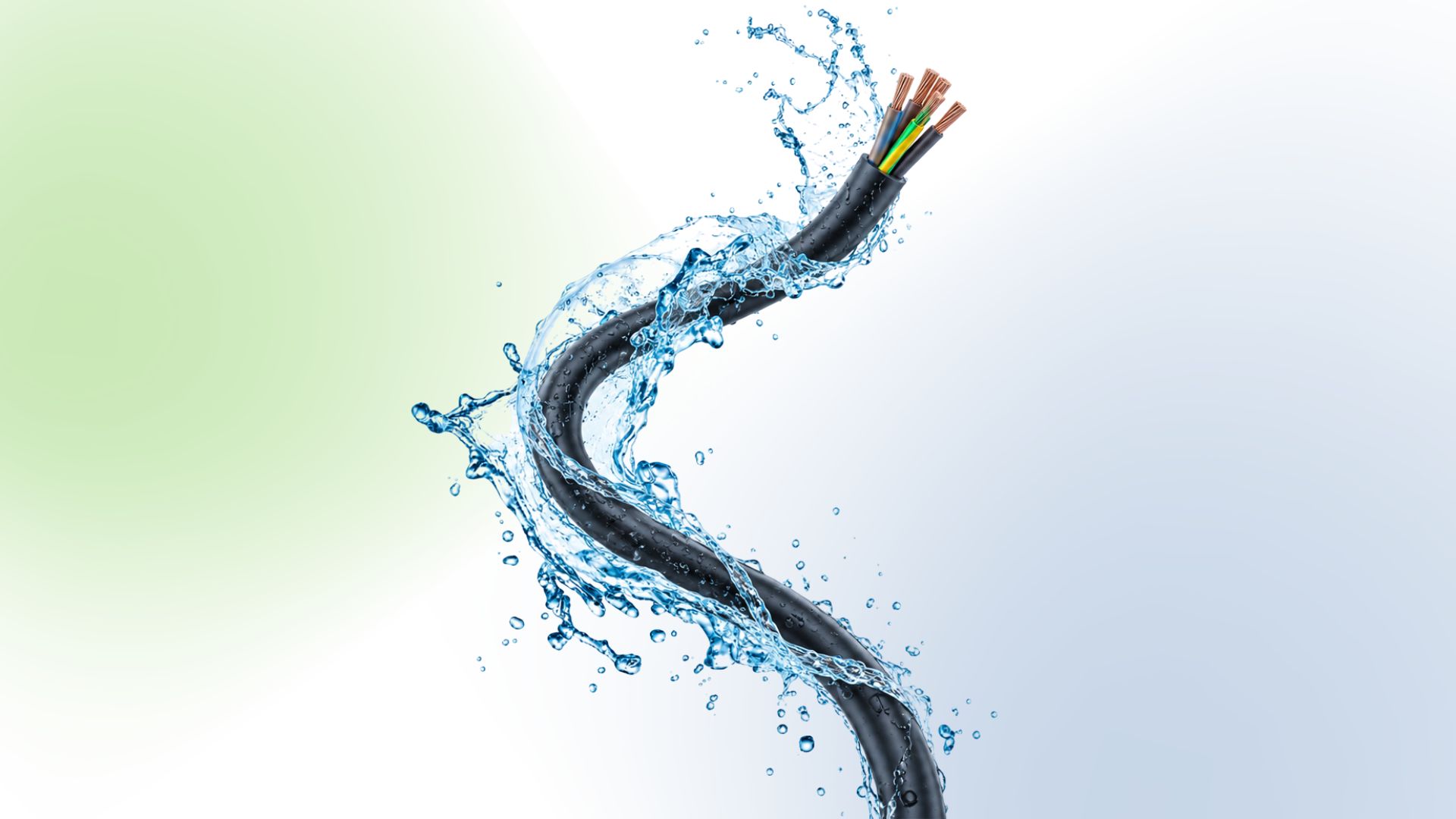
Water resistance: not all cables are the same
A cable installed outdoors must be able to withstand the environmental conditions expected during its operation. However, resistance to rain does not necessarily mean that a cable is suitable for immersion.
Consider, for example, a photovoltaic installation exposed to the elements, an underground power line in soil subject to water accumulation, or equipment operating completely underwater. These are three different situations in which the presence of water can affect the performance and service life of electrical components in different ways.
The key distinction is therefore not simply between a water-resistant cable and one that is not, but between different levels of resistance, defined according to the intended operating conditions.
AD8 classification
To identify different conditions of water exposure, technical standards use a classification indicated by the letters AD, followed by a number. This classification distinguishes various situations, from negligible water exposure to immersion conditions. In particular:
- AD3 and AD4 identify conditions involving rain and splashing water, respectively;
- AD5 and AD6 refer to more demanding exposure conditions, such as water jets and waves;
- AD7 indicates the possibility of temporary, partial or complete immersion;
- AD8 identifies continuous immersion conditions, in which a component may remain completely submerged.
AD8 water resistance is therefore particularly important in applications where exposure to water is not an occasional event, but a prolonged or permanent condition. However, it is still necessary to check the product's technical specifications: suitability for immersion must also be assessed by considering depth, duration, temperature and water characteristics, in accordance with the manufacturer's specifications.
Why is water resistance important?
The presence of water can pose a risk to the integrity and performance of an electrical cable, particularly when the product has not been designed for the environmental conditions in which it is installed. Water ingress can compromise the properties of insulating materials, promote corrosion and reduce the long-term reliability of electrical connections.
For this reason, cable selection must take into account not only electrical characteristics, such as rated voltage and conductor cross-sectional area, but also insulation and sheath materials, installation methods and expected environmental conditions.
Examples of water-resistant cables in the SADA CAVI catalogue
The SADA CAVI catalogue includes a range of solutions designed for applications where water resistance is an important requirement.
When discussing water-resistant cables, the neoprene rubber cable H07RN-F SADARUBBER is certainly worth mentioning. A well-established reference in the industry, it is suitable for permanent immersion at depths of up to 60 metres (AD8).
Another solution is SADASOLAR H1Z2Z2-K Dca AD8, designed for photovoltaic installations, with AD8 water resistance verified in accordance with EN 50525-2-21, Annex E.
A further example is the AL/XLPE/LSHF 1.8/3 kV cable, featuring AD8 water resistance and also suitable for direct burial.
These three products are designed for different applications, but all share a particular focus on water resistance.
Choosing the right cable for the installation conditions
Water resistance is just one of the factors to consider when selecting an electrical cable. Other aspects include operating temperatures, mechanical stresses, weather conditions and installation methods, as well as adequate protection of joints and connections.
Thanks to its extensive product catalogue and specialised technical support, SADA CAVI helps customers identify the most suitable cables for different applications, taking into account the requirements of each installation and the expected environmental conditions.
For further information or assistance in finding the most suitable solution for your needs, contact the SADA CAVI team.
