In our previous article, we looked at how to interpret cable designations according to the Italian CEI UNEL 35011 system, while in the second we explored the European harmonised system HD 361 S4. However, there comes a point when these designations stop being just a technical code and become a practical decision-making tool: that of industrial automation. Within an installation, correctly reading a designation means understanding whether a cable is truly suitable for the application in which it will be installed, in terms of performance, durability and reliability.
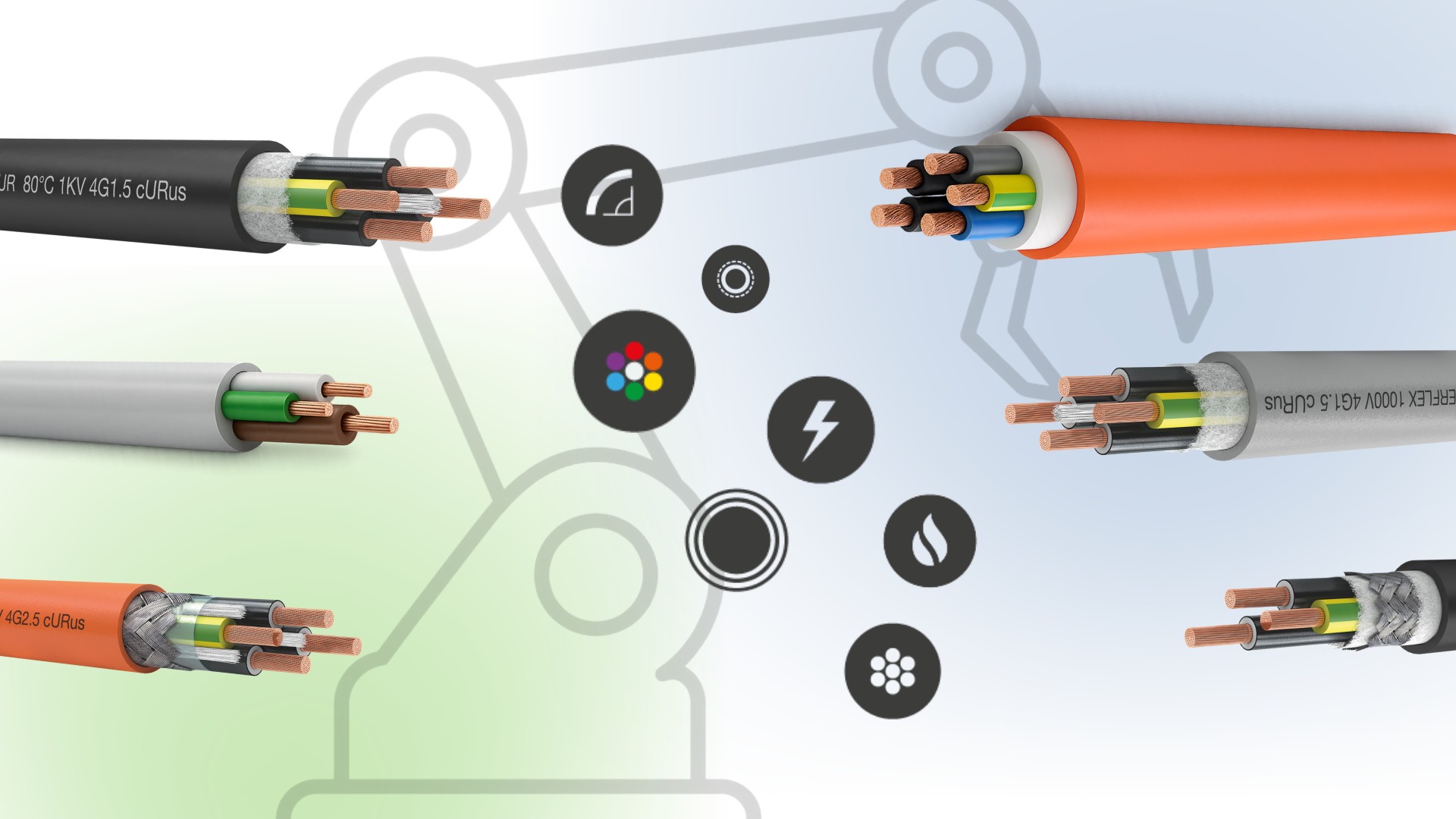
Industrial automation: a specific application context
Industrial automation introduces very specific conditions: continuous movement, torsion, vibration, exposure to oils, and often limited space. In this scenario, every element of the designation helps describe how the cable will perform in operation. For this reason, correctly reading the code means linking technical characteristics to real-world use.
Key characteristics to look for in cable designations
1. Conductor flexibility
One of the first aspects to consider is flexibility. Conductor classes, such as Class 5 or Class 6, indicate how well the cable can adapt to movement. A conductor made of finer strands provides greater flexibility and better resistance to repeated cycles—an essential feature in dynamic applications.
2.Insulation and sheath materials
The letters in the designation also identify the materials used for insulation and sheath. This is particularly important in industrial environments, where cables may be exposed to demanding conditions. Materials such as PVC represent a standard solution, while polyurethane (PUR) offers greater resistance to abrasion and oils. TPE is also used in certain applications for its elastic and flexible properties. The choice of material directly affects the cable’s lifespan and its ability to maintain performance over time.
3.Suitability for movement
Another key aspect is understanding whether the cable is designed to move or not. There are cables intended for fixed installation and others developed for dynamic applications, including continuous movement within cable chains. This information is not always immediately evident, but it is crucial to avoid incorrect use.
4.Shielding and electromagnetic compatibility
In the presence of inverters, motors and drives, electromagnetic compatibility becomes a central issue. Some designations indicate the presence of shielding, such as cables marked CY or CP, which feature a metallic braid. Shielding protects the signal from external interference, contributing to system stability and proper operation.
5.Rated voltage and standards references
Elements such as H05 or H07 indicate the rated voltage and the applicable standards, as discussed in previous articles. Even in industrial settings, these remain important reference points, but they should always be considered alongside mechanical and environmental characteristics.
Practical example: how to read a real designation
To make this more concrete, let’s analyse a real case: SADATRAY CHAIN TC-ER CIC UL LISTED.
The name SADATRAY CHAIN identifies a family of cables designed for dynamic industrial applications, particularly for use in cable chains.
The designation TC-ER (Tray Cable – Exposed Run) indicates a cable certified for installation in cable trays, with the possibility of exposed runs, according to North American standards.
The marking CIC (Control and Instrumentation Cable) indicates that the cable is designed to carry control and instrumentation signals in industrial environments compliant with CSA C22.2 standards.
Finally, UL LISTED certifies that the cable complies with Underwriters Laboratories safety standards, an important reference for industrial applications and international markets.
Overall, the designation describes a cable designed for industrial environments, suitable for movement, easy to install, and compliant with recognised standards.
Common mistakes to avoid
In practice, some mistakes occur frequently: choosing a cable based solely on price, using fixed-installation solutions in dynamic applications, or underestimating the importance of shielding. The installation environment is also sometimes overlooked, with consequences that only become apparent over time, when the system is already in operation.
SPS 2026: an opportunity to learn more
The world of industrial automation will once again take centre stage at SPS Italia 2026, where SADA CAVI will be present with its dedicated solutions.
It will be an opportunity to see automation cables up close, explore their technical characteristics, and better understand how designations translate into real applications within industrial systems.